Showing posts with label spain. Show all posts

Thursday, December 30, 2010

Rizal, Bonifacio, at ang "Pahimakas" ("Mi Ultimo Adios")

by Jesusa Bernardo

PATRIOT Jose P.  Rizal inspired nationalist Gat Andres Bonifacio y de Castro and the rest of the Filipino/Taga-ilog revolutionaries. Despite the fact that Rizal in the end disowned the revolution, his writings, particularly El Filibusterismo and Noli Me Tangere, formed an invaluable inspiration that helped allow or allowed the Supremo to push for the Philippine Revolution against colonial Spain.


We credit and laud Gat Rizal for crystallizing and popularizing the idea of independence and although he did shun it ultimately, it was only because he wanted the revolution to occur under ideal circumstances which he believed was best for the people.

We credit and laud Supremo Bonifacio for organizing and strengthening under very difficult colonial circumstances the Kataastaasan Kagalang-galang na Katipunan ng mga Anak ng Bayan (KKK), that noble society that aimed to liberate the country from the yoke of Spanish colonization.

Rizal provided a great inspiration for a nationwide assertion of independence. Bonifacio gave national life and force to Rizal's "filibuster" Elias character. Gat Rizal was being prudent disowning the Philippine Revolution of 1896. Supremo Bonifacio had the incredible historical foresight to push through with it despite initial lack of arms.

Imagine if the Bonifacio did not do what he did? No Philippine Revolution. The imperialist United States could then have all the right to call us "insurectos" & colonized. No claim to a Filipino-American WAR  (instead of "insurrection" as imperialist North America used to claim) . There would not even be a "President Emilio F. Aguinaldo," no matter that the hero-murderer grabbed power from, and  had the Supremo executed.

Wala sana tayong maipagmamalaking pagkabansa patungkol sa ika-19 na siglo. Kahit na nagapi tayo, naipagmamalaki pa rin natin na isa na tayong bansa na lumaban sa mga mananakop na Kalbong Agila.

The following is the Tagalog translation of Gat Rizal's "Mi Ultimo Adios" ("Last Farewell"), translated no less by Supremo Bonifacio. Written on the eve of Rizal's execution under the hands of the cruel, unjust Spanish colonizers, Mi Ultimo Adios (originally untitled) is considered by some to be his last will and testament to the country. That the Supremo of the Philippine Revolution translated the poem, despite Rizal's opposition to the Himagsikan ng 1896 is proof of Bonifacio's high respect for the inspiration of his independentist ideas and struggle.

Ang "Pahimakas," na salin ni Gat Bonifacio ng Mi Ultimo Adios ni Gat Rizal:


PAHIMAKAS NI DR. JOSE RIZAL
(salin sa wikang Tagalog ni Gat Andres Bonifacio)


Pinipintuho kong Bayan ay paalam,
lupang iniirog n~g sikat n~g araw,
mutiang mahalaga sa dagat Silan~gan,
kalualhatiang sa ami'y pumanaw.

Masayang sa iyo'y aking idudulot
ang lanta kong buhay na lubhang malungkot;
maging marin~gal man at labis alindog
sa kagalin~gan mo ay akin ding handog.

Sa pakikidigma at pamimiyapis
ang alay n~g iba'y ang buhay na kipkip,
walang agam-agam, maluag sa dibdib,
matamis sa puso at di ikahapis.

Saan man mautas ay di kailan~gan,
cípres ó laurel, lirio ma'y patun~gan
pakikipaghamok, at ang bibitayan,
yaon ay gayon din kung hiling n~g Bayan.

Ako'y mamatay, n~gayong namamalas
na sa silan~ganan ay namamanaag
yaong maligayang araw na sisikat
sa likod n~g luksang nagtabing na ulap.

Ang kulay na pula kung kinakailan~gan
na maitim sa iyong liway-way,
dugo ko'y isabog at siyang ikinang
n~g kislap n~g iyong maningning na ilaw.

Ang aking adhika sapul magkaisip
n~g kasalukuyang bata pang maliit,
ay ang tanghaling ka at minsan masilip
sa dagat Silan~gan hiyas na marikit.

Natuyo ang luhang sa mata'y nunukal,
taas na ang noo't walang kapootan,
walang bakás kunot n~g kapighatian
gabahid man dun~gis niyong kahihiyan.

Sa kabuhayang ko ang laging gunita
manin~gas na aking ninanasa-nasa
ay guminhawa ka ang hiyaw n~g diwa
pag hin~gang papanaw n~gayong biglang-bigla.

Ikaw'y guminhawa laking kagandahang
ako'y malugmok, at ikaw ay matanghal,
hinin~ga'y malagot, mabuhay ka lamang
bangkay ko'y masilong sa iyong Kalan~gitan.

Kung sa libin~gang ko'y tumubong mamalas
sa malagong damo mahinhing bulaklak,
sa man~ga labi mo'y mangyaring ílapat,
sa kaluluwa ko halik ay igawad.

At sa aking noo nawa'y iparamdam,
sa lamig n~g lupa n~g aking libin~gan,
ang init n~g iyong pag hin~gang dalisay
at simoy n~g iyong pag giliw na tunay.

Bayaang ang buwan sa aki'y ititig
ang liwanag niyang lamlám at tahimik,
liwayway bayaang sa aki'y ihatid
magalaw na sinag at han~ging hagibis.

Kung sakasakaling bumabang humantong
sa cruz ko'y dumapo kahi't isang ibon
doon ay bayan humuning hinahon
at dalitin niya payapang panahon.

Bayaan ang nin~gas n~g sikat n~g araw
ula'y pasin~gawin noong kainitan,
magbalik sa lan~git n~g boong dalisay
kalakip n~g aking pagdaing na hiyaw.

Bayaang sino man sa katotong giliw
tan~gisang maagang sa buhay pagkitil:
kung tungkol sa akin ay may manalan~gin
idalan~gin Báyan yaring pagka himbing.

Idalan~ging lahat yaong nan~gamatay,
nan~gagtiis hirap na walang kapantay;
m~ga iná naming walang kapalaran
na inahihibik ay kapighatian.

Ang m~ga bao't pinapan~gulila,
ang m~ga bilangong nagsisipag dusa:
dalan~ginin namang kanilang mákita
ang kalayaan mong, ikagiginhawa.

At kung ang madilim na gabing mapanglaw
ay lumaganap na doon sa libin~gan't,
tan~ging m~ga patay ang nan~gag lalamay,
huwag bagabagin ang katahimikan.

Ang kanyang hiwaga'y huwag gambalain:
kaipala'y marin~gig doon ang taginting,
tunog n~g gitara't salterio'y mag saliw,
ako. Báyan, yao't, kita'y aawitin.

Kung ang libin~gan ko'y limót na n~g lahat
at wala n~g kruz at batóng mábakas,
bayang lina~gin n~g taong masipag,
lupa'y asarolin at kanyang ikalat.

At m~ga buto ko ay bago matunaw
máowi sa wala at kusang maparam,
alabók n~g iyong latag ay bayaang
siya ang babalang doo'y makipisan.

Kung magka gayon na'y aalintanahin
na ako sa limot iyong ihabilin
pagka't himpapawid at ang pan~ganorin
m~ga lansan~gan mo'y aking lilibutin.

Matining na tunóg ako sa din~gig mo,
ilaw, m~ga kulay, masamyong paban~gó,
ang úgong at awit, pag hibik sa iyo,
pag asang dalisay n~g pananalig ko..

Báyang iniirog, sákit niyaring hirap,
Katagalugang kong pinakaliliyag,
dingin mo ang aking pagpapahimakas:
diya'y iiwan ko sa iyo ang lahat.

Ako'y patutun~go sa walang busabos,
walang umiinis at verdugong hayop:
pananalig doo'y di nakasasalot,
si Bathala lamang doo'y haring lubos.

Paalam, magulang at m~ga kapatid
kapilas n~g aking kaluluwa't dibdib
m~ga kaibigan bata pang maliit
sa aking tahanan di na masisilip.

Pag pasalamatan at napahin~ga rin,
paalam estran~gerang kasuyo ko't aliw.
paalam sa inyo m~ga ginigiliw:
¡mamatay ay siyang pagkagupiling!
_________


References:

Cruz, Hermenegildo. Kartilyang Makabayan. Lupong Tagaganap" ng ARAW NI BONIFACIO, 1933. Project Gutenberg EBook #148822, January 28, 2005.
http://www.gutenberg.org/files/14822/14822-h/14822-h.htm

Guerrero, Milagros C., Emmanuel N. Encarnacion, & Ramon N. Villegas. Andres Bonifacio and the 1896 Revolution. 16 July 2003. http://www.ncca.gov.ph/about-culture-and-arts/articles-on-c-n-a/article.php?i=5&subcat=13

Photo credits:

http://philippineamericanwar.webs.com/
https://blogger.googleusercontent.com/img/b/R29vZ2xl/AVvXsEhFMjp4QMMkxfQ7vd6ssT58laZO3iwLrCHrQg-r1yefe2KfJ25If-gzHi4psqPHn1z8AAtAvX515kRTzJwD1sB0O7_k0SLc0jU1lG6N9SsgHNmNd5wF6bKZKfilQwrnhJKq6WaTWnK9LlM/s1600-h/book02.jpg
http://www.knowledgerush.com/kr/encyclopedia/Spanish-American_War/

Monday, September 13, 2010

Gen. Macario Sakay's Vilification: Anatomy of the nefariousness of American Imperialism

IN the morning of September 13, 1907 at around 8:30 am, two Malay-skinned men sporting long, uncut but luxuriant hair were led out of the bartolina in Manila in the Southeast Asian archipelago now called the Republic of the Philippines. The two protagonists were escorted by pale-skinned soldiers of the Bald Eagle nation from the North American continent towards the gallows to be executed by hanging. Upon reaching the platform, one of the long-haired Filipinos, the seeming leader, shouts from the top of his lungs:
“I face the Lord Almighty calmly but we must tell you that we are not bandits and robbers as the Americans accuse us, but members of the revolutionary force that defended our country. Long live the Philippines! Adios Filipinas!”

JB poster art


Who was Sakay?

Macario Sakay y de León was a Filipino military  leader in the Philippine Revolution against Spain and in the Philippine-American War (1899-1914). He  had fought side by side with Gat Andres  Bonifacio y de Castro, Supremo of the secret-society-turned-revolutionary-government Kagalanggalangang Katipunan  nang  manga Anak nang  Bayan (KKK). Following the second  phase of the Revolution and  the capture or  surrender of most Filipino generals by the invading  Americans, he later continued resistance against the  new colonial enemy, the United States. He was initially  caught and then released following the official  declaration of the war's end in 1902.

The following year, Sakay became  President of the Republic of Katagalugan  (Philippines), the revived Katipunan during the fight  for freedom against the invading Bald Eagle nation. Gen. Sakay proved to be a big, big thorn to the  American imperialist agenda. In battling the vile  Bald Eagles, his nationalist determination and vision showed his Tagalog Republic to be the true heir to  the Katipunan government and him, the proud heir to the Supremo. A tough, determined, "organization  genius" of a Filipino patriot, Sakay defiantly and,  for a time, rather wondrously continued the anti-colonial mission of   KKK and Gat Bonifacio.

Sakay engaged in guerrilla warfare against the  imperialist Americans, utilizing crafty planning and  organizational force to accomplish military victories.  His  government utilized "a large number of rebels  against a small group of American soldiers to  guarantee a successful ambush attack [and usually  attacking] at night when most of their enemies are  asleep."  The Katagalugan freedom fighters would  seize firearms and ammunition in their raid  attacks in Cavite and Batangas and even San  Francisco de Malabon. They had a big haul of ammunition and revolvers from a U.S. military garrison--a minor feat they achieved while disguised as Philippine Constabulary men.

Gen. Sakay made it known to the enemy imperialists  that they were freedom defenders of a most patriotic  and advance order. The Katagalugan Republic had  its Katipunan-based flag, constitution and seal. The Republic's  Declaration  had the KKK character of the  equality of every person regardless of race, skin  color, wealth, intelligence and appearance as it  exalts every individual's 'essential nature'  (loob)  instead.  The Declaration also included the whole of  the archipelago:
Ang mga Nayon, bayan Hucuman nitong Filipinas ay  siyang tinatauag na Kapuluang Katagalugan, sa  macatuid baga, ay gaya ng Jolo, Mindanao,  Kabisayaan, Kailokohan iba't iba pang lupa na tunay  na Tagalog.[28]
(The villages and municipalities of this Filipinas are called Katagalugan Archipelago, which in effect, are  the likes of Jolo, Mindanao, Visayas, Ilocos and all  other different lands that are truly Tagalog.)


Unfortunately, Sakay would ultimately be conned by the vile Americans into coming down from the mountains on promise of amnesty for him and his officials, on top of the formation of Philippine Assembly composed of Filipinos that would supposedly serve as the "gate of freedom." The imperialist American Governor General Henry Clay Ide used Dr. Domingo Gomez, a Filipino labor leader and 'persuasive and charming ilustrado,' to lure Sakay into giving up their resistance.

Gomez met with Sakay at his camp and argued that  the establishment of a national assembly was being  held up by Sakay's intransigence, and that its  establishment would be the first step toward  Filipino independence. His surrender was made to  be a prerequisite for a state of peace that would  supposedly ensure the election of Filipino delegates to the (1907) American-sponsored Philippine Assembly. Sakay , in good faith, was convinced by the  smooth-tongued Gomez that the struggle has shifted to  constitutional means, with the Assembly as means  to winning Philippine Independence.  He finally  agreed on the conditions that a general amnesty be granted his men, that they be permitted to carry  firearms, and that he and his officers would be  permitted to leave the country. Gomez assured  Sakay that these conditions the would be acceptable  to the Americans, and Sakay's emissary, General  Leon Villafuerte, obtained agreement to them from  the American Governor General.

Thereafter, Sakay and Villafuerte traveled to  Manila, where they were welcomed and invited to  receptions and banquets. One invitation came from  the Constabulary Chief, Col. Harry H. Bandholtz.  That invitation was a colonial trap and Sakay and  his principal lieutenants were disarmed and arrested  while the party was in progress. Sakay's group were naturally taken aback, with Gen. Villafuerte shouting: “We have been betrayed and we are trapped. Doctor, what is the meaning of this?” As Guerrero further recounts, Gomez could only reply with: “There’s no use fighting.”  For his part, Sakay, with bloodshot eyes, exclaimed: “Tell the Americans to face us in the open field, in honorable battle.” Sakay also asked how the Filipino Constabularios managed to have no shame betraying their fellow Filipinos and being subservient to the colonizers.

American Colonizers Hang Filipinos
Sakay and company were then forcibly brought to the Hotel de Oriente in Binondo before being incarcerated in Bilibid Prison. Captain Rafael Crame presided over their preliminary investigation before being charged of bandolerismo under the Brigandage Act  of Nov. 12, 1902 that construed all acts of  armed resistance to American colonial rule as banditry. The Katagalugan President and his men were defended by Attys. Felipe Buencamino and Ramon Diokno (father of  the noted human rights lawyer Jose Pepe Diokno) but the colonial Supreme Court of the Philippines would upheld the  decision.
 
In between, the nefarious Americans did not bother keeping their promise even towards the lower ranked men of Sakay. Inside the Bilibid prison, the North American colonizers secretly killed, nay, murdered 400 of Sakay's men by hanging and by lethal serum. As Guerrero notes, the prison atrocities perpetrated by the Americans against the Tagalog Republic patriots can be likened to the recent Guantanamo and Abu-Ghraib scandals.

As for the Filipino traitor character that was Dominador Gomez, it turned out that he allowed himself to be an imperialist tool of treachery in order to save his own skin. Gomez was a doctor who had been convicted of sedition and fined and sentenced to four years of hard labor. He had taken over the leadership of the labor federation Union Obrera Democratica de Filipinas and having participated in a big rally, he was arrested by the colonial authorities. He had his case under appeal when he negotiated for Sakay's surrender. Two weeks after Sakay was hanged, Gomez won the appeal as the Appeals Court judged the evidence against him insufficient no matter the "much suspicious proof."


 Late A Hero Recognized


This author is among those who were virtually taught  the American propaganda as to Sakay's identity. I remember that in my elementary or high school years, the history books' slant pictured Sakay as a Filipino bandit more than a hero. For about half a century after the US granted the Philippines "independence," imperialist propaganda against a valiant patriot who continued the anti-colonial mission of the "Father of Philippine Revolution," Supremo Bonifacio well persisted.

Carmen Guerrero Nakpil perhaps well describes  Sakay's patriotic military career:
Sakay became the scourge of all his country's  oppressors - the Spaniards, the Americans, the  misguided half-bloods and compatriots - trying in  every way he knew to secure freedom from injustice  for his people. He was more determined than Rizal,  more fortunate than Bonifacio, purer than  Aguinaldo, more lyrically mysterious than Mabini. If  Filipinos had won the war with America, he would  probably have been our Simon Bolívar or our Ho Chi  Minh.


It took a century and a year before the official recognition of the heroism, valor, and patriotism of Sakay and the Tagalog Republic cabinet and soldiers were made by his compatriots. Or a half a century and two years after the American invaders supposedly granted independence to the Filipinos on July 4, 1946.

It took long before it came--that rightful recognition to strike off the lingering American "bandit" smear campaign and  to finally elevated Sakay to the pantheon of Philippine heroes, but came it finally did. In 1998, the Manila Historical and Heritage Commission unveiled a life-size status of Gen. Sakay at Plaza Morga in Tondo, his birthplace. Earlier, the University of the Philippines and the National Historical Institute unveiled a marker at the foot of Mr. Banahaw, part of the region where the Republika ng Katagalugan freedom fighters operated amidst the American Occupation of the archipelago.

On September 16, 1998, a sweet statement of a recognition was passed by the Philippine Senate of the 14th Congress when it passed Resolution No. 121 "HONORING THE SACRIFICE OF MACARIO SAKAY AND ALL OTHER FILIPINOS WHO GAVE UP THEIR LIVES IN THE PHILIPPINE-AMERICAN WAR FOR OUR FREEDOM."

The "Whereas" clauses of the resolution sets straight the facts of the circumstances of Gen. Sakay's activities and execution. Sakay <issued a manifesto declaring the Filipinos' right to self-determination at a time when calling for "independence", espousing and advocating the same, was considered a crime by the American occupation forces in the Philippines;> He established the freedom-fighting or defiant <"Republika ng Katagalugan", of which he was the president and Francisco Carreon as the vice president.>

It was but natural for the imperialist American authorities not to have recognized Sakay's Republic. The Bald Eagle people, after all, did not even recognize the fledgling 1898 Philippine Republic led by Gen. Emilio Aguinaldo, the man they conned into cooperating in the war against Spain and letting them freely enter the archipelago as they positioned themselves for the Mock Battle of Manila and eventual invasion/occupation.

According to the Senate Resolution, the <the Philippine Commission passed the Bandolerism Act which proclaimed all captured resistance insurgents to be tried in court as bandits, ladrones and robbers.> Sakay was then declared an outlaw under the Bandolerism Act.>

However, Sakay was such a tough freedom fighter and an "organization genius."  The resolution continues: <Despite the establishment of concentration camps by the Philippine Constabulary and Philippine Scouts in Cavite, Batangas and Laguna, this did not stop Macario Sakay and his companions to expansively fight in the Southern Luzon area.>

Original seal of President Macario Sakay/Katagalugan Republic
(with photoshop coloring/art)


Bald Eagle No Mercy

A day before the execution of Sakay and de Vega, a big, emotional crowd demonstrated before Malacanang, then the seat of American colonial power. The people wished to convince the imperialist Gov.-Gen. Henry Clay Ide not to push through with the execution. They pleaded for clemency; however, Ide coldly refused to even see the people.

A day after the execution of the virtual second Supremo of the Katipunan government, the fourth de facto President of the Philippines (after Bonifacio, Emilio Aguinaldo, and Gen. Miguel Malvar), a larger crowd appeared before the Bilibid prison vociferously asking that they be allowed to wrap his and de Vega's bodies with the flag of the Katipunan. Again, the native supporters and sympathizers of Sakay and the Tagalog Republic were heartlessly turned down.

The subjugated Filipinos could make no such demand. The imperialist Americans won't allow honor of any kind to be conferred to the Filipino who defied and battled their immoral dominion and prolonged the non-Muslim component of the Philippine-American War.

Wicked, vilification propaganda to project a patriot  as bandit was certainly not enough for the Bald  Eagle. Blatant deception by the colonial  governor-general and the exploitation of another native in dire straits were not not enough either.  The US Army's dishonorable violation of its own safe conduct pass was not enough as well. Not even the  legalized murders of the leaders of the Tagalog  Republic would suffice. Even in Sakay's death,  North American imperialism showed no mercy.


Greatest and Last Filipino General, President

 But why is that? Why so much hate against Sakay, "Uncle Sam"? Sakay's history seems to show that the pale-skinned North American  imperialists let out all their brand of wicked  ammunition on him and the Tagalog Republic  patriots.

Hard to imagine the powerful, Bald Eagle invaders vilifying a sagacious and determined freedom fighter like Sakay. Imagine democracy-touting Americans committing genocidal-level Guantanamo/Abu-Ghraib precedents on the Katagalugan patriots some 100 years before the  administration of George W. Bush, the  war-freak "Idiot Heir."

But con, vilify and murder the "bandit" Republic of Katagalugan freedom fighters they did. Imperialist American nefariousness, circa 1900s. A portent of Agent Orange, circa Vietnam War, and sheer imperialist terrorism, circa Iraq War.

Why so? The terroristic Americans ain't saying it but they seemed to have found Gen. Sakay the last and the greatest Filipino general to have challenged their bald-hearted imperial might.

By the way, merely seven weeks following their execution of President Sakay, the imperialists passed Act No. 1696, or the Flag Law that prohibits the public display of all Philippine and  Katipunan flags, banners, emblems, and symbols....


____________


References:


Guerrero, Milagros, Emmanuel Encarnacion, and Ramon Villegas. Andres Bonifacio and the 1896 Revolution. In Sulyap Kultura. National Commission for Culture and the Arts, 1996. NCCA Site. 16 June 2003. http://www.ncca.gov.ph/about-culture-and-arts/articles-on-c-n-a/article.php?i=5&subcat=13.


Guerrero Nakpil, Carmen. "The mark of Sakay: The vilified hero of our war with America." Philstar. Updated 8 September 2008. http://www.philstar.com/Article.aspx?articleid=398995


Hernandez, Jet. MACARIO SAKAY AND THE STRUGGLE FOR FREEDOM. 17 Jan. 2008. http://banlawkasaysayan.multiply.com/photos/album/1/MACARIO_SAKAY_AND_THE_STRUGGLE_FOR_FREEDOM_mula_sa_jethernandez.multiply.com


Macario Sakay. Global Pinoy. http://www.globalpinoy.com/ch/ch_category.php?category=heroes&name=Macario%20Sakay&table=ch_heroes&startpage=16&endpage=30


Pomeroy, William J. The Philippines: colonialism, collaboration, and resistance. Publisher International Publishers Co, 1992. http://books.google.com.ph/books?id=vQPpEa02N5kC&dq=%22an+aspect+of+the+u.s.+educational+system+was+the+selection+and+elevation+of+national+heroes.%22&source=gbs_navlinks_s


Transcript from Philippine Senate Resolution No. 121, September 16, 2008, http://www.senate.gov.ph/14th_congress/resolutions/resno121.pdf


Photo credits:

(Sakay seal): http://www.watawat.net/; https://www.facebook.com/p
hoto.php?fbid=10150100309784077&set=t.1792989548&type=1&theater

http://www.freewebs.com/philippineamericanwar/thelastholdouts.htm

Monday, April 05, 2010

Philippine Lent 2010 from the lens of a doubting patriot


I gave in to taking part in the Catholic Filipino tradition of “Visita Iglesia”, a form of penitence involving the visit to 14 (or lesser variations) Churches and the solemn prayer of  the Stations of the Cross in each stop. The Good Friday experience somewhere in the north comes not from the perspective of a religious devotee but, rather, from an open-to-religion nationalist student of history who can’t seem to let go of the blows Western colonialism dealt to the pride of her race, the indigenous people of the isles called the Philippines.

My group completed seven Catholic Churches, each of which was marked by purple drapes covering all the icons in the altar, chancel, nave and sometimes the narthex area of the temple interior. Not everything was covered, so I had the chance to marvel at the spiritually uplifting beauty of Christian architecture and dome painting and, in some instances when the karo slated for the Easter procession were already being prepared, even the icon sculpture. Beyond the artistic merits of Churches in the Philippines, my Visita Iglesia got me to contemplate on the role Christianity played in the colonial history of Filipinos and Filipinas.

Purple/Dark Violet Drapes of Lent

The Catholic Church & Spanish Colonization of the Philippines

While most of the religious tour members prayed or read from the Stations of the Cross pamphlets at every church stop, I got myself to kneel and sit down on a pew. I engaged in a sort of meditation, true, but it was more of my mind drifting to the Spanish colonial times and wondering how the Christian religion factored in three centuries of subjugation of the peace-loving early Filipinos.


How could the Christ, a holy embodiment of sacrifice and martyrdom, have given rise to a religion propagated by forcible means of colonization, at least during the height of the Church's power? How is it that Christ’s name was used by the alien Spaniards in the colonial, unkind, unjust, even racist, control of the primarily Malay and Indones people of “Las Islas Filipinas” and the exploitation of their natural resources? Did not those Spaniards (and the Pope's Church for that matter) find it unchristian and blasphemous to advance their empire’s interest with the use in part of God’s name?

How about having used Filipino elites to control the masses, as well as the pitting of “indios” against fellow“indios” from different regions to maintain colonial dominion of the archipelago? How easy was it for those Spanish friars and government officials to gloss over the immoral, unholy incongruence of Christ’s teachings with colonialism? Nineteenth century propagandist hero Graciano Lopez Jaena perhaps gives an answer with his Fray Botod character --a fat and lecherous priest with a false piety that always had “the Virgin and God on his lips no matter how unjust and underhanded his acts are."

Spanish colonial era Philippine Church (Photo Credit: www.rms-gs.de/)

As I was looking at the pews lit by the stained-glass filtered sunlight, I imagined how some 200 or so years ago, pious, meek, more-or-less downtrodden brown-skinned Filipinos heard mass officiated by some friar who stood out both by way of his pale-skinned, chiseled-nose features and his power over the sea of “subjects” inhabiting his king’s territory-archipelago in the Southeast.


“Kandarapa” Good Friday Penitents

In between Church stops, our group was treated to what foreign tourists would describe as the “spectacle” of self-flagellating penitents. Virtually in all the routes leading to every church we visited, numerous mortifying half-naked, masked men did their thing. Those we caught lying prostate caused us some traffic delays.  Looking at their very bloody red backs, I initially thought they were “colored by some red dye applied to the whips because they just seemed so red and so rather profuse to be real, but real blood it was.

Lenten Self-Flagellants Prostrate
The penitents scourged themselves with whips (”burillos” supposedly tipped with sharp objects, such as bamboo splices) while in sort of processional route to a church. A few carried a cross but in all cases, the penitents seemed to have made periodic stops in which they laid more or less prostrate on the hot ground while some assistant(s) did the whipping of the back and even the legs using the penitents’ lash or some other whip.

Burillo/Penitent Whip
Locals supposedly call the Good Friday penitents “kandarapa.” The mortification ritual is part of the kandarapa's “panata” or religious pledge, often made either in the bid to make God forgive or their sins or to ask for some difficult favor for themselves or some loved ones. The ritual serves as a reenactment of the passion of Jesus Christ while on the way to his crucifixion. The prostrate move, with arms outstretched and legs held straight together, symbolizes Christ's crucifixion on the cross.

The history of Lenten self-flagellation is uncertain but a commonly accepted version is that “Penitente are descendants of the Third Order of Saint Francis of Assisi,” with members who were basically lay people wanting to follow Christ’s teachings (or footsteps literally?). Spain brought the ritualistic practice to the Philippines and later, Filipino penitents supposedly compared their enactment of Christ’s Passion with the sufferings they endured under the abusive hands of the Spanish colonizers, specifically the friars and landlords.

Self-flagellation
Today, the Catholic Church in the Philippines makes it known that it officially disapproves of the practice of Lenten mortification, including the more extreme nailing to the cross mainly seen in the province of Pampanga. Makes me wonder whether the church ban in fact began during the colonial times when the practice the Spaniards themselves brought assumed the character of being a reflection of the injustice they wrought on the conquered natives of the land.


Colonizers Long Gone?

At the turn of the 19th century, the combined strength of local revolutionaries-transformed-into-Filipino soldiers and United States military forces drove the Spanish colonizers out of the country. American imperialist propaganda, however, made it appear that Spain "sold" its colony the Philippines to the US under the Treaty of Paris. The Philippine-American War ensued but the fledgling Philippine eaglets were no match for the colonizing bald eagle and the rest is mostly more unfortunate history.

Today, more than a century later, there are no more Spanish friars but only Filipino priests in the Southeast Asian archipelago. Although perhaps made not so obvious with its persisting colonial name of Philippines,* the country proclaims itself a wholly independent republic. How is it, therefore, that Lenten self-flagellation persists despite the Catholic Church's expressed disapproval? Could it be that vestiges of colonization remain in the former Spanish and American colony and that the self-flagellation ritual forms a way of showing to the Christian world the prevailing hypocrisy of the ruling elites, locals and otherwise, in their rule over the land?


King Philip II
*The Philippines was named after King Philip II (El Rey Felipe II), the reigning monarch during the time the archipelago was first settled/colonized by Spain. It was called Las Islas Filipinas and Philippine Islands during the Spanish and American colonial period, respectively.


References

Lent and Moriones. Center for Southeast Asian Studies, Northern Illinois University Site. http://www.seasite.niu.edu/Tagalog/Cynthia/festivals/lent.htm

Rudea, Diana. Flagellation: Lent in the Philippines. 23 March 2008. http://english.ohmynews.com/articleview/article_view.asp?menu=c10400&no=382155&rel_no=1

Smith,  Jeffrey S.  Los Hermanos Penitentes: An Illustrative Essay. 70 A The North American Geographer.  http://www.k-state.edu/geography/JSSmith/Penitente_Photo_Essy.pdf

Tiatco, Pineda Anril and Bonifacio-Ramolete,  Amihan. Cutud’s Ritual of Nailing on the Cross: Performance of Pain and Suffering. Asian Theatre Journal – 25. 1, Spring 2008, pp. 58-76. DOI: 10.1353/atj.2008.0014

Photo Credits:

http://www.bbc.co.uk/
http://www.trekearth.com
http://www.travellog.com
http://fiveprime.org/
http://www.rms-gs.de/phileng/history/kap01.html
http://myjosept.blogspot.com/2008/03/bisita-iglesia.html
http://flickr.com/photos/32736561@N00/126305659
Wikipedia

Sunday, May 10, 2009

Andres Bonifacio's Tagalog Nation & Predictions of Global Warming (Bonifacio Series II)

A CENTURY and nearly a score years ago today, a most patriotic and fervent hero of a land to the southeast was executed by his coup plotting secret enemies during the peak of his people's struggle for national independence. The revolutionary leader was Andres Bonifacio y de Castro, murdered May 10, 1897 in a remote mountain in the archipelagic islands the hero called the Haring Bayang Katagalugan (Sovereign Nation of Katagalugan.) The name "Katagalugan," derives from"Tagalog," which is a constriction of the word "taga-ilog" that translates as "(person/people) from the area along the river," or simply, riverine. The hero's treacherous execution marked not only the elite takeover of the revolutionary mass movement he built but, as well, the adoption of a colonial name for his country well past into its independence period until today. Tagalog was junked and the old name given by Spain after its king, Philip II, stuck. Called "Las Islas de Filipinas" by Spain--a name favored even by its other elitist heroes--or "Philippine Islands," by its next colonial master, the United States of America, it is now called the Republic of the Philippines.

 The emerging global cataclysm of global warming, however, may just give the people of Bonifacio's Tagalog islands--the "Filipinos" of today--the unlikely opportunity of reverting to the non-colonial country name that reflects and asserts their precolonial heritage, and nationalist identity and aspirations. The predicted rise of sea levels due to the ongoing climate change may swamp Manila and other low-lying areas, cleansing their nation of the selfish, unpatriotic elites of class and mind in the process. A cleansing that can be likened to the Babylonian and Biblical stories of the Deluge, which would purify the population of its protracted alienation from its Malay roots--to allow the archipelago to assume the more endemic, nationalist name of Tagalog.  


Predictions of Climate Change Devastation

 Global warming is an emerging cataclysm such that even critics of the anthropogenic-climate-change theory concede that its impacts are now upon all the inhabitants of this planet. While scientists are yet uncertain of whether global warming affects El Nino and other climatic variability changes, they are more confident that it is an irreversible phenomenon that would impact regional extremes in temperature, seasonal precipitation, seasonal temperature, global average temperature, atmospheric carbon dioxide concentration, and tragically, the average level of sea waters. The countries that scientists consider to be most vulnerable are the low-lying areas, particularly archipelagic countries in Asia, such as Bangladesh, Cambodia, India, India, Vietnam, Indonesia, and the Philippines. According to a scientist from the Australia-based Center for Australian Weather and Climate Research, the most plausible climate change scenario by the end of the century is a total sea-level increase between 1-2 meters.


An Inundated Philippines
The Philippines is an archipelago of over 7,000 islands and islets shaped like scattered pearls and lying approximately 500 miles off its coast. It has an irregular configuration, the coastline of which extends over 21,500 miles. Its topography and geology depicts a beauteous piece of nature's work--coral, volcanic, principal rock formations, and diverse mountain ranges that mostly run along the direction of the islands themselves and that host some 3,000 endemic and unique species of plants and over 500 of the 700 known species of coral in the world. While its highest peak, Mt. Apo in Mindanao, stands at nearly 9,700 feet, the central plain of Luzon, the biggest island where the capital Manila lies, rises only a mere 100 feet above sea level. According to the World Wildlife Fund for Nature (WWF), global warming could submerge areas of Manila and eradicate a number of entire islands of the Philippine archipelago. Based on data gathered for the Intergovernmental Panel on Climate Change (IPCC), a rapid increase in sea levels, from between 20-40 centimeters has been observed between the 1960s and the present. This sea-level rise around the Philippine coast is at least partly due to melting glaciers and higher temperatures of ocean waters. Based on a high IPCC-predicted A2 scenario of a 100 cm sea-level rise by 2080, 5,000 hectares of the coastal region of Manila Bay would become regularly inundated. The Sulu Sea and Tubbataha Reef waters are also expected to warm and face rising atmospheric carbon dioxide levels from 2ppmv-4ppmv annually. Greenpeace Southeast Asia warns that a one-meter sea-level increase would affect 64 of the total 81 provinces, covering over 700 of the 1,610 towns. Combining these three scenarios, total inundation within this more conservative one-meter-rise prediction would cover nearly 700 million square meters of Philippine land between 2080 and 2100.
 Predictions of an inundated Philippines are not limited to scientific studies of climate change. This author is reminded of psychic forecasts dating back to the 1970s that predicted Metro Manila will be submerged in the future. At that time, logical attempts to interpret such predictions (of which Filipinos are fond of) centered on the Manila Bay reclamation project implemented by the Ferdinand Marcos administration.


Psychic "Apo," who correctly predicted United States President Barack Obama's 2008 electoral win by a one-third advantage*, sees a similar scenario probably happening for the countries in Southeast Asian. He even goes on to say that Filipinos should perhaps try to emigrate to higher-lying countries that include Israel and those in the West. Backed up by science and sensed by "psychics," the strong likelihood is that the Philippines several decades from now will be radically different. Areas of Manila--the former seat of colonial Spain and colonial America and today's political center and seat of elite power--as well as other parts of Central Luzon could transform into rivers, while low-lying small islands and islets could be swallowed up by the ocean waters. Such a scenario could gravely impact not only the fortunes of the general population but as well, those of the ruling elite. Apart from the initial economic damage from structural and infrastructural destruction and relocation and other costs, political power and organization may be physically and symbolically encumbered, given that the presidential residence, Malacanang, lies within Manila. This could be aggravated by the prospect that the higher-lying Makati City, the country's business center, could be cut off from other areas, to be connected only via river navigation.  


Possible Filipino Elite Response: Emigration

Such a drastic environmental change could just prove too much for an elite class generally used to reigning over the rest of the population and owning much of the islands. With their fortunes amassed through the century or centuries of predatorily staying on top of the socio-economic ladder, they have the resources to save their skins and emigrate out of the Philippines at will. As easily as members of this same class have been historically co-opted by the Western colonialists with whom their ancestors interbred, these largely mestizo elites could, and would, easily and unremorsefully abandon a sinking archipelago.  


Filipino Elite Exodus & the Rebirth of Tagalog Nation

 Drastic and shocking as it may be, any such exodus of Filipino elites may just bring in the unexpected blessing of a nationalist rebirth. Any such global-warming-caused inundation of the Philippines, and the expected emigration of the jetsetting rich class, could serve to purify the archipelago of political and cultural affinities with the two Western countries that conquered its people and pillaged its identity. When the deluge of global warming does drive the easily co-optive elites away from the country they half-heartily love and barely serve, who will be left are the Filipino masses without the resources to take the easy way and flee. This same socio-economic group without the means to emigrate is the Filipino class that has long been deprived of the opportunity to overcome the economic and social inequities and rise above their lowly existence.


Without the original patriotism-bereft elite class to exploit them, and imperialist nations to take interest, the future people of an inundated Philippine islands could seize the opportunity to rise from the ravages of flooding to form a new, moral and glorious nation as the Father of the Philippine Revolution, Andres Bonifacio, envisioned in the late 1800s. With only the masses and middle class around, and shielded from Western colonial exploitation by its partly submerged state, the population who will be left to face the geographic challenges of the impact of global warming could take a liberating nationalist course away from their delimiting colonial mentality, best represented by their country's name, the Philippines. Seeing the new rivers created from the old lands, they could be inspired to rechristen their country with the same name that the great but betrayed leader Bonifacio earlier gave, Tagalog.  


"Philippines" vs. "Tagalog"


 It is a deplorable fact that despite the colonial roots of the name Philippines, it has not yet been dropped except briefly during the revolutionary struggle against Spain. From the time of the American Occupation to World War II until today, only one and unsuccessful attempt to have it changed was ever seriously made. During the Martial Law period under Marcos, Senator Eddie Ilarde did propose a name change to Maharlika ("warrior–noble" during the pre-colonial days before the National Assembly,but it was rejected for one reason or another.


Back in the late 19th century, the Reformist heroes Jose Rizal, Marcelo H. del Pilar, and Graciano Lopez Jaena, who spoke and struggled against colonial injustice suffered by their countrymen but nonetheless still looked up to Spain and aspired for representation in the Spanish legislature, batted for the name "Filipinas." Bonifacio chose a noncolonial name Tagalog, which the other revolutionary leaders clearly acknowledged as representing the whole areas of the archipelago. Presumably, they wished the new and native-derived name to bring out the country's natural features of having numerous river systems and an archipelagic coastline. A few months before Bonifacio was murdered, a Spanish periodical referred to him as the revolutionary head of the country, Titulado ‘Presidente’ de la Republica Tagala.


The name Tagalog today strictly refers to a region in Central Luzon where the Tagalog dialect is spoken. Apparently the term has been localized by elitist historians who wish to belittle Bonifacio's revolutionary heroism. While the term Tagalog was long used, perhaps before his time, it is to the credit of the revolutionary leader that he insisted on a name that gives an endemic meaning devoid of colonial subservience. Perhaps, Bonifacio did not only have the great patriotism and genuine nationalism that allowed him to build the K.K.K., or Kataastaasan Kagalang-galang na Katipunan nang manga Anak nang Bayan (Highest, Noblest Society of the Children of the Country) revolutionary movement. It could be that the Supremo had the psychic wisdom that the country he dearly loved and fought for would literally be a riverine nation. Without the ravaging elements of attachment to its colonial masters of the past, the "Tagala" people of Andres Bonifacio's archipelago could build a new land founded on the genuine brotherhood and sisterhood of its Malay people. In such a prediction of a ravaged but purified nation, the Tagala people will claim a riverine land cleansed of its woeful colonial past, but grateful of the patriotic struggles and aspirations of its heroes and heroines of the old.

The Decalogo & Rise of the Tagalog Nation Beyond the reversion to the indigenous name of the country, if the risen Tagala people will also be faithful to the principles and aspirations of the Katipunan, they will perhaps resurrect or revisit Andres Bonifacio's Dekalogo (Decalogue). Revealing the depth of the patriotism and political morality of the Supremo, it was written to provide the revolutionaries with a ten-point "duties of the children of the country," as follows:
1. Love God with all your heart. 2. Implant it in your heart that the true love for God equates with true love for one's Land of Birth, which is also love for others. 3. Nurture it in your heart that the true value of honor and comfort is for you to die in defense of Motherland. 4. Your every good aim will meet triumph if you exercise composure, patience, reason and hope in your deeds and acts. 5. Take good care--as you do your honor--the mandates and aspirations of the K.K.K. (Highest, Noblest Society of the Children of the Country). 6. It is the responsibility of all to help anyone in grave danger of reneging on his/her duty, even at the risk of losing one's life and resources. 7. Our strength of will and our discipline in carrying out our duties will serve as examples to others. 8. Share what you can to anyone in need and less fortunate. 9. One's industry in his/her source of livelihood is the genuine source of love, of love of self, of your spouse and children, of your siblings and compatriot. 10. Punish anyone who's evil and traitorous and commend good works. Believe that the teachings of K.K.K. are graces from God; that what the Motherland aspires for, are also the wishes of God. (Translation by the author from the Dekalogo)
In the 1920s, President Manuel L. Quezon, the first Philippine leader under American rule, expressed the belief that "Nothing depicts and portrays the character" of the great anti-colonial national hero more than the Dekalogo (Note: the Dekalogo was replaced by the Kartilya or Primer of the Katipunan, written by Emilio Jacinto, upon Bonifacio's humble deference to his revolutionary compatriot and friend). If the future people of the Southeast riverine land will abide by it, the Dekalogo should be enough to make the new nation indeed the 'most exemplary' in the world. As the renewed people of the Pearl of the Orient Seas shall have turned their backs on a colonial name and identity and the corruption such alienation helped wrought, so then shall proudly stand the virtuous, nationalist Republika ng Tagalog, and the Supremo will look down from the heavens and beam with exalted joy.  


Notes: *Psychic Predictions on Estrada, Arroyo, the US & the World. 19 October 2008. Jesusa Bernardo Newsvine Column. http://jesusabernardo.newsvine.com/_news/2008/10/19/2016629-psychic-predictions-on-estrada-and-arroyo-the-us-obama-the-world Related Andres Bonifacio article by the author: Bernardo, Jesusa. Gat Andres Bonifacio: The Anti-Colonial National Hero of the Philippines (Bonifacio Series I). 30 Nov. 2009. http://forthephilippines.blogspot.com/2008/11/andres-anti-colonial-national-hero-of.html _____________  

References:

Burgonio, TJ. Global Warming Threatens to Sink Half of Navotas. 30 April 2007. Consequences of Global Warming Site. http://globalnation.inquirer.net/news/news/view/20070430-63180/Global_warming_threatens_to_sink_half_of_Navotas

Cruz, Hermenegildo. Mga Tanong at Sagot Ukol Kay Andrés Bonifacio at sa KKK. 1922. Maynila. Project Gutenberg EBook of Kartilyang Makabayan, by Hermenegildo Cruz. 28 January 2005. ftp://opensource.nchc.org.tw/gutenberg/1/4/8/2/14822/14822-h/14822-h.htm#D

Cueto, Francis Earl. Philippines: Country ¡®shrinks¡¯as sea level rises. 8 February 2007. http://www.ccchina.gov.cn/en/NewsInfo.asp?NewsId=7088 Global Climate Change: Country and Regional Information. http://www.usaid.gov/our_work/environment/climate/country_nar/philippines.html

Guerrero, Milagros, Emmanuel Encarnacion, and Ramon Villegas. Andres Bonifacio and the 1896 Revolution. In Sulyap Kultura. National Commission for Culture and the Arts, 1996. NCCA Site. 16 June 2003. http://www.ncca.gov.ph/about-culture-and-arts/articles-on-c-n-a/article.php?i=5&subcat=13 Hutme,

Mike and Nicola Sheard. Climate Change Scenarios for the Philippines. http://www.cru.uea.ac.uk/~mikeh/research/philippines.pdf "Philippines."  

Encyclopædia Britannica. 2009. Encyclopædia Britannica 2006 Ultimate Reference Suite DVD 10 May 2009 .

Quezon, Manuel L. "Andres Bonifacio, The Great Plebeian." Historical Bulletin 7.3 (September 1963 [1929]): 245-248. In Bonifacio Papers, 2 Jan. 2006. http://bonifaciopapers.blogspot.com/2006/01/quezon-manuel-l.html

Quimpo, Nathan Gilbert. Colonial Name, Colonial Mentality and Ethnocentrism. KASAMA. Vol. 17 No. 3 (July–August–September 2003). Retrieved from http://cpcabrisbane.org/Kasama/2003/V17n3/ColonialName.htm

Rodis, Rodel. 'Maharlika’ Reconsidered. 2 September 2008. http://globalnation.inquirer.net/mindfeeds/mindfeeds/view/20080902-158208/Maharlika-Reconsidered  

Sea Level Rising in the Philippines. Updated Mar 16, 2009 http://www.siiaonline.org/?q=programmes/insights/sea-level-rising-philippines

Photo Credits:

Museo Oriental de Valladolid Site

Carbon-Based-ghg.blogspot.com
Global Warming.blogspot.com
National Geographic
Brett Davenport's Travel Blog Destination360 Site
EcoDestination.com
NASA ABC News.net
WorldNews.com
Bayanihan Post.com
The News Today.info
 Bayaning Pinoy Wordpress.com Jibrael Angel Blog @blogspot.com
Environmental Protection of Asia.com Wikipedia

(Updated 18 May 2009) ******************

Saturday, January 03, 2009

An Asian Tomcat Myth

Of all the animals that roamed the earth, cats perhaps form the species associated with the most exotic, regal and most number of myths and superstitions. Cats became no less than objects of worship during the time of ancient Egypt, with domesticated cats being accorded the ultimate respect of mummification followed by cemetery burial. In Europe in the Middle Ages, cats suffered three centuries of persecution, including summary killings and torture, borne out of their association with witches and witchcraft. In the 17th century, cats regained public favor when the court under French Cardinal Richelieu began the trend of keeping them.

Today, superstitions such as a black cat crossing the path of a person as bringing bad luck, and myths, such as these feline creatures having nine lives, survive. In Asia, one of the fascinating cat myths has to do with its males or tomcats. The myth concerns the belief that tomcat sporting furs of three colors, and which survive into adulthood, get to reign as "king" (presumably of a territory it is able to roam).

King Tomcat

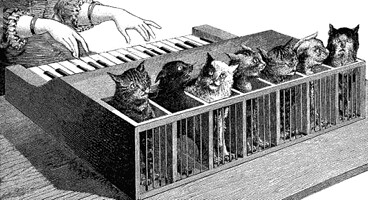
This cat myth is still told in parts of the Southeast Asian country, the Philippines. Incidentally, the Philippine archipelago, is a former Spanish colony named after King Philip II under whose honor was invented the cat organ, a public musical-cum-torture instrument wherein boxed cats were made to howl (in pain) as their tails tied to an organ keyboard were jerked with the pounding of the keys.

This king tomcat myth has a rather grim component. Supposedly, so that cats (or male cats only ?) would not have to be burdened by the future rule of a king cat, adult male cats kill, nay, murder, all male kittens with three-colored coats. Animal grim and really fantastic-sounding.

A Childhood Myth

I have lived with cats and dogs around since I could remember. Ours was the typical Filipino family that nurtures pets as driven by both utilitarian and companionship perspectives: dogs are bantay (guards) against intruder as cats are against, well, rodents. Amidst this animal-friendly environment, this tomcat story became a fixture in my mind. Well, at least ever since my father and siblings figured I was old enough to comprehend stories.

Even at a young age, such a story sounded like a tall, leaping tale to me. I was perhaps of pre-school age when I began dismissing the tomcat story as incredible--despite the seemingly serious countenance of my father from whom I remember first hearing the oft-told story. How could cats know all that? How could cats know the idea of a king? More incredibly, how could cats know a king based on an outside feature--something like based on one's clothes (or skin color)? In adult terms, what my young mind was basically saying was that such a tomcat story couldn't be true because to believe so would assume that cats have a sophisticated culture that takes care of the process of social order. It assumes that elite cat dominance is based not on the usual "physical might is power" but rather, on a summary selection process that is both racist and sexist.

Of course, as I entered schooling years, I came to "recognize" the story as a superstition, an animal myth. But stories around the tomcat myth persisted. I heard more than once that rich fellows are able to keep three-colored male kittens alive to adulthood by caging or enclosing them as a way to protect their special pets from murderous feline attacks. Convinced that the story is nothing but "superstition," I did not bother with finding out its veracity or otherwise. I soon lived, grew up and matured without giving any further thought to this male cat myth, although I must say that I don't think I have ever seen a tomcat with three-colored fur (supposedly, any color combination) in the neighborhood.

Kitten Murders & the Tomcat King

It would take some three decades later before this tomcat king story would be resuscitated in my mind. One early morning a few years ago, my husband and I went to visit my parents' grave nearby while our kids were still asleep. I remember that I left the backdoor open because we only planned to stay in the cemetery for a short while. Coming back, we were surprised by the sight of one of the newborn kittens of our female cat lying dead on the floor near our old sofa chair.

A few days earlier, our female cat with a three-colored coat had delivered a litter of 4 (or 5?) kittens to nurse, and subsequently brought her babies to the space underneath the sofa through a torn part of the leather upholstery. Fearing the worst, I stooped down to push the torn leather and to check underneath. What I saw was almost something straight from Discovery Channel's features of murder-capable animals such as lions and chimps. All of the kittens--all of which had similar three-color patterns as their mother--were dead and all of them had blood and bite marks on the neck.

It was a ghastly sight, but which jolted the tomcat story out from the deep recesses of my memory. Blurting out the possibility of the truth of a three-colored future cat king, I asked my husband to check out the sex of the dead kittens. He checked out at least three of the four and reported that two were males. Putting two and two together, I remembered a big white tomcat circling around some two days earlier. Oh dear, I cried. So the tomcat story is true!? Cat murder and the feline king tale seemed definitely real at that point. For a time, I blamed myself for forgetting to lock the door through which the "wicked" tomcat probably got in.

Three-Colored Cat is "Calico"

Searching for answers to mystery, I scoured the Internet using <"cat myth" three colored> and , and other combination search words. It was then that I learned that male cats are sometimes capable of murdering kittens they did not sire--much like lions often do. I also learned that cats having furs with three colors are called Calico cats and that Calico tomcats are biologically rare. More than ninety percent of the time, Calico felines are females because fur color is a sex-linked trait, specifically linked to the X chromosome of which female have two while males only have one. Calico males are a rarity and tend to be sterile.

Is the kitten murder solved then? The question is whether the scientific explanation satisfies the incident. Firstly, on account of the culprit suspect tomcat, we can never be sure but the scenario is possible because I did leave the door open for the murder. On account of the Calico kittens, there were at least two males in the litter, with all of the kittens in the litter having three-colored coats.

Cat Myth and Science

Were the kittens murdered by the sex-craving of a tomcat, or because the litter contained future cat kings then? That feline beast possibly did want to mate with my female cat and to make her sexually receptive, conveniently killed her litter without animal remorse. Then again, such seemed a one-in-a-million incident because I'm certain that what happened to those poor three-colored kittens was the first ever case of feline murder in our household (out of the many kitten litters our female cats have given birth through the decades). The set of kittens was also the first case of a pure Calico litter and male Calico we ever had. My husband swears that he checked for the gender and saw at least one--for certain, but perhaps at least two--of the murdered Calico kittens was male. Too much of a coincidence, or a plain coincidence? Did the Calico litter killing spring from murderous sex craving, or from a cat culture humans are unaware of or unwilling to recognize?

I must admit I find it tempting to view this story of the feline murder of the Calico litter as a case of anecdotal evidence for the tomcat king angle, as much as an unfortunate cat story explainable by genetics and a not uncommon behavior among male members of the cat species. To hold on to the tomcat king myth amidst scientific and plausible explanations is, of course, ridiculous. Nonetheless, the myth showcases the fascinating literary creativity and ingenuity of the early Filipinos in explaining the rarity of Calico males.

_______

References:

Borinsky, Jeffrey. "Cat Organ." Mechanical Music Digest. May 1998. http://www.mmdigest.com/Archives/Digests/199805/1998.05.12.07.html

Crosby, Janet. Are Calico Cats Always Female? http://vetmedicine.about.com/od/catbreed1/f/FAQ_calicocats.htm

Is it true that cats with three colors have relatively shorter lifespans than those that have one color or two? http://www.answerbag.com/q_view/447758

Sunquist, Mel and Sunquist, Fiona. The Domestic Cat: History, Folklore, Ecology, and Behavior. In Wild Cats of the World. The University of Chicago Press, 2002. University of Chicago Press Site: http://www.press.uchicago.edu/Misc/Chicago/779998.html

Why most calico cats are female? http://catfactsparadise.blogspot.com/2008/03/why-most-calico-cats-are-female.html

Maternal Aggression in Cats. PetPlace.com Site.www.petplace.com/cats/maternal-aggression-in-cats/page1.aspx

Photo Credits:

http://catfactsparadise.blogspot.com/2008/03/why-most-calico-cats-are-female.html

http://farm4.static.flickr.com/3086/2355696504_8773cd25de.jpg

http://askville.amazon.com/male-calico-cats-worth-money/AnswerViewer.do?requestId=26434222

http://kittymeowtoys.com/cat-pictures/v/Asian_Group_cats_gallery/tiffanie+kittens+belong+to+Asian+Group+breed.jpg.html

http://images.google.com/url?source=imgres&ct=ref&q=http://damecarcass.blogspot.com/2008/03/they-betrayed.html&usg=AFQjCNHJ8AQI0PMEDcKrzzOHd_0SB1_w1Q

http://images.google.com/url?source=imgres&ct=ref&q=http://www.solarnavigator.net/egyptian_cat_mummies.htm&usg=AFQjCNHm1cGpdJdI8mU8w96mbtdpTXqo1w


****************


Popular Posts